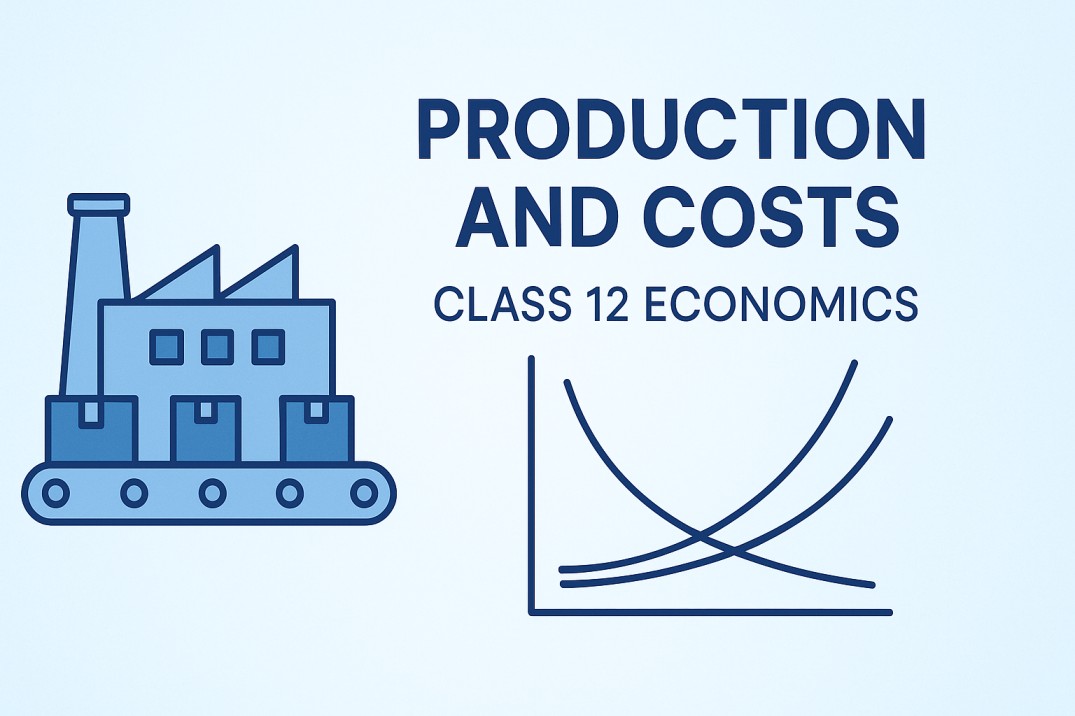
Production and Costs: Class-12
Understanding how goods and services are created is at the heart of economics. Whether it’s a local bakery producing bread or a multinational company manufacturing smartphones, every business goes through a similar journey of turning inputs into outputs. This entire process falls under the study of Production and Costs.
What is Production?
Production refers to the process of converting inputs (like labour, machinery, raw materials, and land) into outputs (finished goods and services). It is not just about making goods; it is also about adding value. For example, turning wheat into bread or cotton into clothes makes the products more useful to consumers.
Types of Inputs
Inputs are broadly classified into:
-
Fixed Inputs
These inputs remain constant in the short run. For example, factory buildings, machinery, or land. A bakery cannot instantly change the size of its shop even if demand rises suddenly. -
Variable Inputs
These can be changed easily based on production needs. Hiring extra workers or buying more raw materials are common examples.
Short Run vs Long Run
In economics:
- Short Run is a period where some inputs are fixed.
- Long Run is a period where all inputs can be varied. Firms can scale up operations, buy new machinery, or shift to bigger locations.
The Production Function
A production function shows the relationship between inputs used and output produced. It helps firms understand how different combinations of labour and capital affect production.
One key idea here is the Law of Variable Proportions. It explains how output changes when only one input is increased while others are fixed. Production typically goes through three stages:
-
Increasing Returns to a Factor
Output increases at an increasing rate. Workers coordinate better, machinery is used efficiently. -
Diminishing Returns to a Factor
After a point, adding more units of the variable input results in a slower increase in output. -
Negative Returns
Too many workers and not enough equipment leads to inefficient production, causing total output to fall.
What Are Costs?
Costs are the expenses incurred by a firm in the production process. Knowing your costs is crucial for setting prices, planning output, and earning profits.
Types of Costs
-
Fixed Costs
Costs that do not change with the level of output. Examples include rent, salaries of permanent staff, and insurance. -
Variable Costs
Costs that vary with production. Raw materials, electricity used in production, and wages of daily workers fall under this category. -
Total Cost (TC)
The sum of fixed and variable costs: TC = TFC + TVC -
Average Cost (AC)
Cost per unit of output.
AC = TC / Output -
Marginal Cost (MC)
The cost of producing one extra unit of output. MC is very important for decision-making because firms compare it with revenue to decide how much to produce.
Cost Behaviour in Short Run
In the short run:
- Fixed costs remain constant, so when output increases, average fixed cost falls.
- Variable costs rise as output rises.
- The MC curve typically falls first due to better efficiency and then rises because of diminishing returns.
Cost Behaviour in Long Run
In the long run, firms can change all inputs. There are no fixed costs.
Here, costs are affected by:
-
Economies of Scale
When expanding production reduces average cost. This can happen due to bulk buying, advanced technology, or better management. -
Diseconomies of Scale
When the firm becomes too large and average cost starts rising due to coordination problems or inefficient management.
Why Production and Cost Analysis Matters
Understanding production and costs helps firms decide:
- How much to produce
- What input combination gives the best results
- At what level costs are lowest
- How to maximize profit in the long run
It also helps governments and policymakers understand how industries operate and how to support them.
:max_bytes(150000):strip_icc():format(webp)/marginalutility-cff85ddfd620484f8afbf9d3f6cf4b74.jpg)
:max_bytes(150000):strip_icc():format(webp)/TermDefinitions_Utility-e42a7528caa347f9b1af149065ab2b9d.jpg)