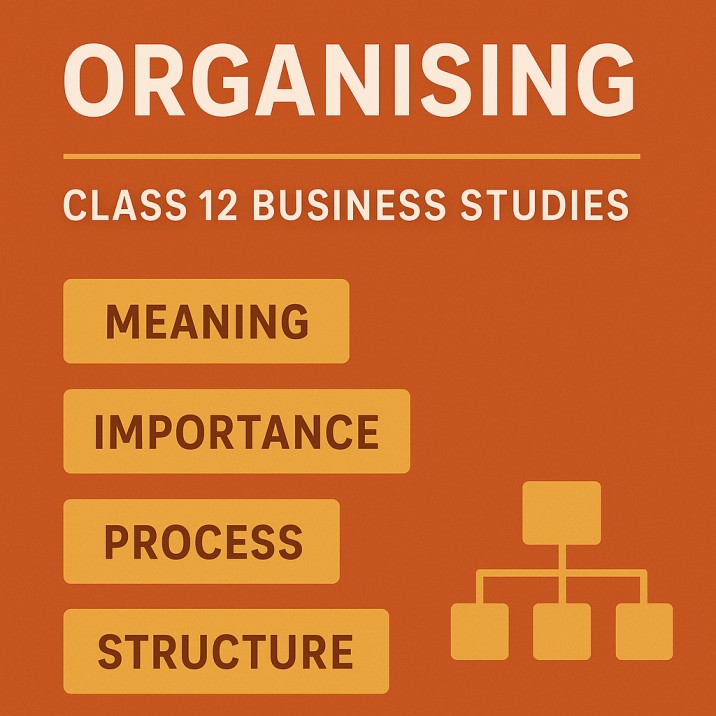
Organising – Class 12 Business Studies
Meaning of Organising
Picking a path starts by spotting what’s needed, grouping alike jobs, then passing them along depending on who handles which piece. This system ties positions to clear work through confidence or guidance - no rigid control. Goal? Line up hours, energy, tools, and funds wisely, skip the clutter.
---
Features of Organising
1. Division of Work
Breaking tasks down divides work into small chunks - making it easier to handle when zeroing in on particular abilities.
2. Grouping of Activities
Roles that seem similar get grouped into areas such as selling, handling cash, picking people for roles, or building products.
3. Assignment of Duties
Individuals receive assignments suited to their strengths - matching skills with responsibilities in a natural way.
4. Delegation of Authority
Employees receive authority from managers to handle their tasks.
5. Establishing Relationships
A clear chain of command - alongside set channels for updates - keeps confusion from cropping up.
---
Importance of Organising
1. Specialisation
Tasks are broken down - after that, shared based on skills, so everything moves faster.
2. Clarity in Working Relationships
Figuring out positions makes it clear who reports to who - so there’s less confusion or stepping on toes.
3. Optimum Use of Resources
Folks alongside tools are used well.
4. Adaptation to Change
A straightforward plan helps the team adjust when things around them change - by working with what's on hand, trading outdated methods for fresher approaches as they go.
5. Coordination
Putting alike jobs together keeps team coordination smooth by reducing friction.
6. Efficient Administration
Clear tasks make it easier for bosses to work - because each person gets what’s theirs to manage.
---
Organising Process
1. Identifying and Dividing Work
The whole task gets noticed first - after that, it’s broken down into tiny pieces through various stages.
2. Grouping Activities
Roles that seem similar are grouped, after which they’re passed to particular squads.
3. Assigning Duties
A single individual decides who does what across groups.
4. Delegating Authority
Employees receive approval from managers before taking on tasks or making decisions when necessary.
5. Establishing Reporting Relationships
A clear layout shows exactly who reports to who.
---
Organisation Structure
1. Functional Structure
Folks are grouped based on their jobs - say, hawking goods, managing cash, building things, or working face-to-face with others.
Advantages:
Specialisation
Better cooperation among team members
Easier supervision
Disadvantages:
Departmental conflicts
Slow decisions holding back each team - while stalling momentum across other areas too
2. Divisional Structure
People are grouped based on what they offer, their location, or the folks they help.
Advantages:
Quick decision-making
Better accountability
Flexibility
Disadvantages:
Costs more since stuff’s often stolen
Factions could end up clashing on their own
---
Delegation of Authority
Elements of Delegation:
1. Power to pick outcomes.
2. Doing your part means handling what’s yours - no dodging it.
3. Being responsible means you’ve got to answer for the outcomes.
Handing off jobs lightens a boss’s load - meanwhile, it helps workers grow their abilities.
---
Decentralisation
Decentralisation involves handing decisions over to lower-level managers rather than keeping them at the top.
Benefits:
Faster decisions
Improved employee motivation
Red
Less stress for top managers
Firmer hold - also keeps you more aware
:max_bytes(150000):strip_icc():format(webp)/marginalutility-cff85ddfd620484f8afbf9d3f6cf4b74.jpg)
:max_bytes(150000):strip_icc():format(webp)/TermDefinitions_Utility-e42a7528caa347f9b1af149065ab2b9d.jpg)