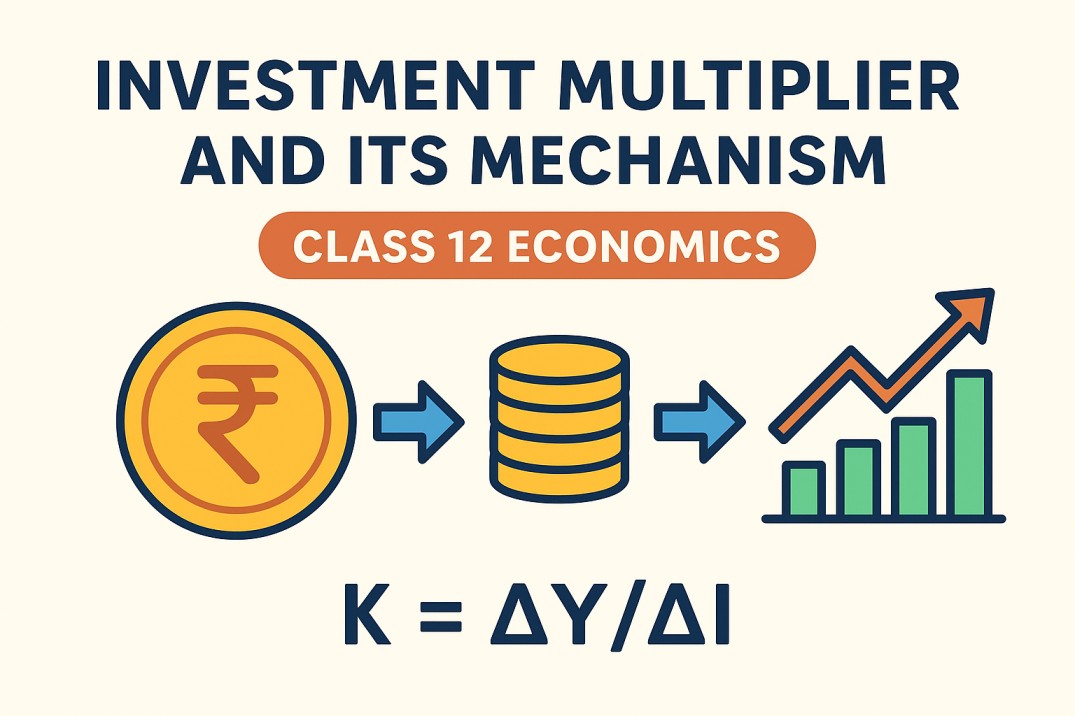
🏦 Measurement of National Income – Class 12 Economics
Have you ever wondered how we figure out the total income of an entire country? Just like we calculate our own monthly income, a nation too measures its overall earnings — and that’s what we call National Income. It helps us understand how well our economy is doing and how the wealth is shared among the people.
🌍 What is National Income?
National Income refers to the total value of all final goods and services produced within a country in a given period (usually a year).
In simple words, it’s the money value of everything produced by the people of a nation, whether goods like cars and clothes, or services like teaching and banking.
It shows the economic performance of the country and helps the government plan budgets, policies, and development programs.
📊 Basic Concepts Before Measurement
Before we jump into the methods, let’s understand a few key terms:
-
Gross Domestic Product (GDP):
Total value of all goods and services produced within the domestic territory of a country in a year. -
Gross National Product (GNP):
GDP + Income earned by citizens from abroad – Income earned by foreigners in our country. -
Net National Product (NNP):
GNP – Depreciation (wear and tear of machines, buildings, etc.) -
National Income (at factor cost):
NNP (at market price) – Indirect Taxes + Subsidies
🧮 Methods of Measuring National Income
Economists use three main methods to calculate a country’s national income. Each looks at the economy from a different angle.
1. Income Method
This method adds up all the incomes earned by people and businesses in the country.
It includes:
- Wages and salaries (for labor)
- Rent (for land)
- Interest (for capital)
- Profits (for entrepreneurs)
Formula:
National Income = Wages + Rent + Interest + Profit
Example:
If a factory worker earns ₹30,000, a landlord earns ₹10,000 rent, and the owner earns ₹20,000 profit — total income = ₹60,000.
2. Expenditure Method
This method looks at how much money is spent on goods and services produced in the country.
It includes:
- Consumption by households (C)
- Investment by businesses (I)
- Government expenditure (G)
- Net exports (Exports – Imports)
Formula:
NI = C + I + G + (X – M)
Example:
If people spend ₹100 crore on goods, the government spends ₹50 crore, and exports exceed imports by ₹10 crore, total = ₹160 crore.
3. Output (or Product) Method
This method adds up the value of final goods and services produced by all sectors — agriculture, industry, and services — within a year.
To avoid double counting, only the final value of goods is included (not intermediate goods like raw materials).
Formula:
National Income = Sum of value added by all sectors
Example:
If the agriculture sector adds ₹500 crore, manufacturing adds ₹700 crore, and services add ₹800 crore → Total NI = ₹2,000 crore.
⚖️ Avoiding Double Counting
If we count both raw materials and final goods, we’ll overestimate the income.
So economists use the value-added method, which means we only count the extra value each stage adds.
Example:
Farmer sells wheat for ₹100 → Baker makes bread and sells for ₹150 → Value added by baker = ₹50 (not ₹150 again).
📈 Why Measuring National Income is Important
- Helps know the economic growth of a country.
- Aids in policy formation by the government.
- Shows the standard of living of citizens.
- Helps compare different countries’ economies.
- Guides investment and business planning.
⚠️ Difficulties in Measuring National Income
- A lot of unrecorded activities, like household work, go uncounted.
- The informal sector in developing countries is huge.
- Data collection is hard and time-consuming.
- Price changes (inflation) affect comparisons over time.
🧠 Conclusion
Measuring National Income is like taking the economic “report card” of a nation. It shows how much a country earns, spends, and grows over time.
Even though it’s not perfect, it’s one of the best ways to understand our economy and make better decisions for the future.
✍️ Quick Recap
| Method | What it Measures | Formula |
|---|---|---|
| Income Method | Total income earned | NI = Rent + Wages + Interest + Profit |
| Expenditure Method | Total spending | NI = C + I + G + (X – M) |
| Output Method | Total production | NI = Sum of Value Added |
:max_bytes(150000):strip_icc():format(webp)/marginalutility-cff85ddfd620484f8afbf9d3f6cf4b74.jpg)
:max_bytes(150000):strip_icc():format(webp)/TermDefinitions_Utility-e42a7528caa347f9b1af149065ab2b9d.jpg)