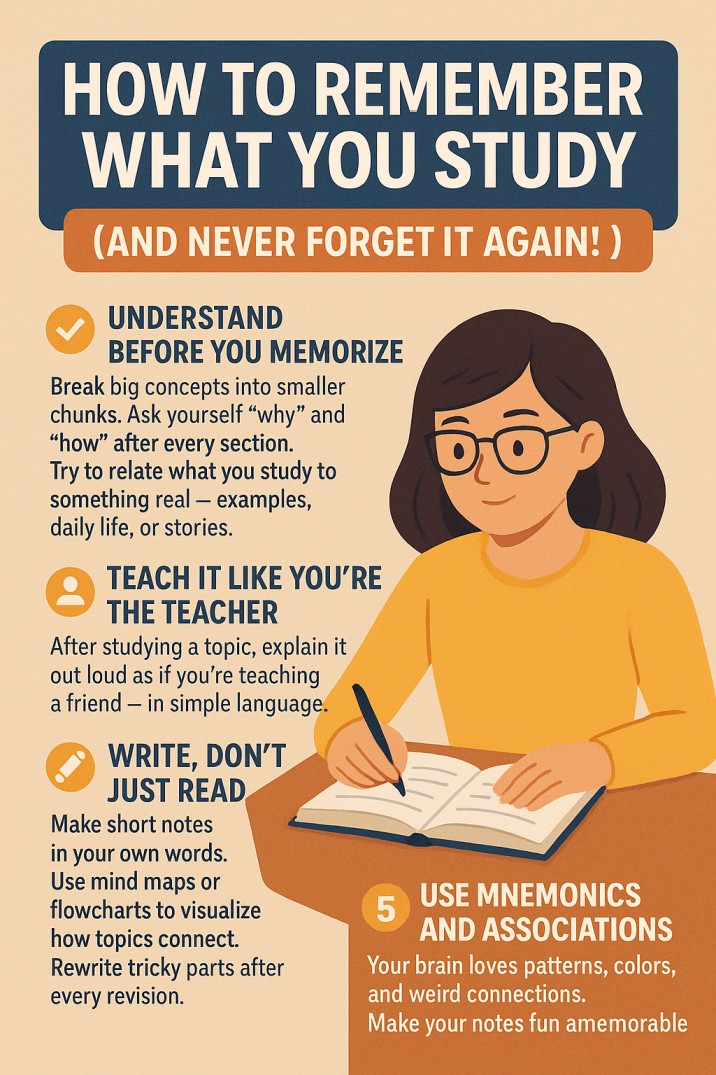
🧠 How to Remember What You Study (and Never Forget It Again!)
Ever read a whole chapter only to realize… you remember nothing? 😩
Yeah, we’ve all been there — highlighting, re-reading, and still blanking out when it actually matters.
Good news: remembering what you study isn’t about being a genius. It’s about studying smarter, not harder. Let’s talk about how to make knowledge stick — with some brain-backed techniques, memory tricks, and small daily habits that actually work.
🎯 1. Understand Before You Memorize
Here’s the truth: your brain can’t store what it doesn’t understand.
If you just try to “mug up” words without context, your memory will bail out fast.
✅ Break big concepts into smaller chunks.
✅ Ask yourself “why” and “how” after every section.
✅ Try to relate what you study to something real — examples, daily life, or stories.
When your brain connects information with meaning, it sticks naturally.
🗣️ 2. Teach It Like You’re the Teacher
One of the most powerful techniques ever: the Feynman Technique.
After studying a topic, explain it out loud as if you’re teaching a friend — in simple language.
If you struggle to explain it, that’s your clue to review it again.
Teaching forces your brain to organize information clearly — and that’s where memory magic happens.
✍️ 3. Write, Don’t Just Read
Reading passively doesn’t help memory much. But writing activates your brain differently.
📝 Make short notes in your own words.
🧩 Use mind maps or flowcharts to visualize how topics connect.
📒 Rewrite tricky parts after every revision — it helps reinforce what you’ve learned.
Basically, don’t just read through your notes — interact with them.
🔁 4. Revise Smart with Spaced Repetition
You don’t need to study something 10 times in one day.
You need to study it once — and review it at the right intervals.
That’s what the spaced repetition method does.
Here’s a simple schedule:
- Day 1 – Learn it
- Day 2 – Revise it briefly
- Day 4 – Quick review
- Day 7 – Test yourself
- Day 15 – Final recap
Each review strengthens memory so it lasts longer. Apps like Anki or Notion Flashcards make this easy.
🧩 5. Use Mnemonics and Associations
Your brain loves patterns, colors, and weird connections.
Make your notes fun and memorable.
Examples:
- 🌈 Use color coding for topics.
- 🔠 Create acronyms (like “HOMES” for the Great Lakes — Huron, Ontario, Michigan, Erie, Superior).
- 🤯 Link facts to funny visuals or stories — the crazier it is, the easier to recall.
💤 6. Don’t Forget Sleep and Breaks
Memory isn’t built while studying — it’s built while resting.
Your brain organizes and stores new info when you sleep.
So:
- Sleep at least 7 hours every night.
- Take short breaks between long study sessions.
- Go for a walk, stretch, or listen to music — it helps your brain reset.
⚡ Final Words: Train Your Brain Like a Muscle
Remembering what you study isn’t luck — it’s a habit.
Understand deeply, revise smartly, teach others, and treat your brain well.
When you combine focus, technique, and rest, your memory becomes unstoppable.