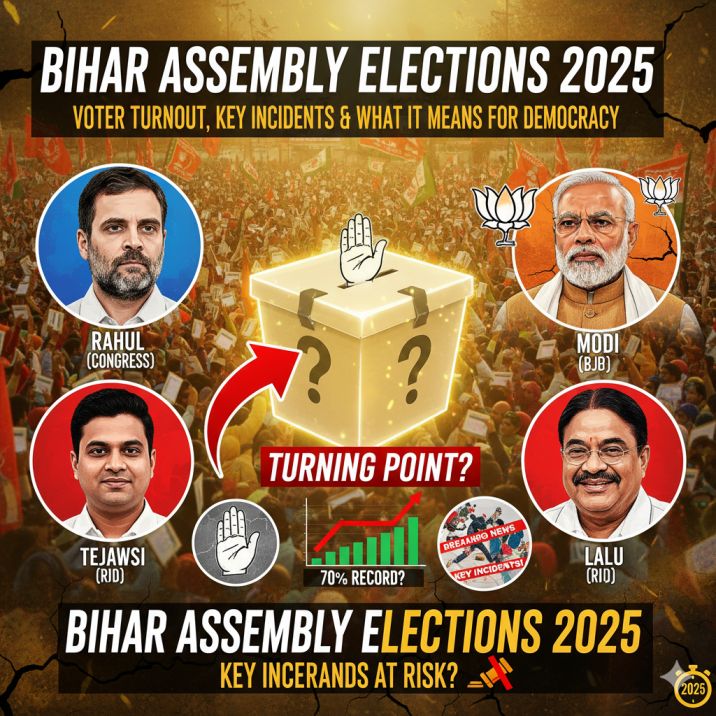
Bihar Assembly Elections 2025: Voter Turnout, Key Incidents and What It Means for Democracy
Introduction
The first phase of the Bihar Assembly elections on November 6, 2025 drew a steady wave of voters across 121 constituencies in 18 districts, with the Election Commission reporting a voter turnout of 60.13% till 5:00 PM. This turnout — coming amid high political stakes, intensive campaigning, and heated rhetoric — is as much a civic statement as a political metric. In this long-form analysis we walk through the turnout patterns, district-level snapshots, the Chhapra incident involving a CPM MLA's vehicle, key constituencies to watch, and what the trends may mean for party strategies and governance going forward.
Why turnout matters: more than just a percentage
Voter turnout is the single most tangible measure of democratic participation on polling day. It reflects not only the intensity of campaigning but also voters' confidence, access to polling booths, weather and logistics, and — crucially — how engaged citizens feel about the choices at stake. A 60.13% turnout by 5 PM signals robust engagement compared to many recent state polls, especially given that Bihar has mixed urban-rural dynamics and deeply localised voting patterns.
District-by-district snapshot: where turnout surged
By 5 PM, several districts stood out:
- Begusarai — leading at ~67.32%, showing strong rural mobilisation and intense local campaigning.
- Gopalganj — ~64.96%, a sign of organised ground efforts and high local interest.
- Muzaffarpur — ~64.63%, typical of constituencies with competitive local races.
- Patna — ~55.02%, slower earlier in the day but picking up pace as the day progressed.
Meanwhile, urban pockets like Bankipur registered lower percentages — a reminder of persistent urban apathy in some metros when compared to rural enthusiasm.
Key constituency reads: what the micro-numbers tell us
Looking at specific constituencies is crucial for predicting seat outcomes. For instance:
- Raghopur: 64.01% — a sign the contest here remains highly engaged and possibly unpredictable.
- Mahua: 54.88% — comparatively lower, signalling either voter fatigue or satisfaction with incumbent outcomes.
- Chapra (Saran): 56.32% — turnout strong but overshadowed by a troubling incident (see below).
The Chhapra incident: what happened and why it matters
In Chapra (Saran district), reports surfaced that the vehicle of a CPM legislator was attacked. While election day sees heightened emotions, any violent incident raises direct concerns about voter intimidation and election security. Election observers and law enforcement must ensure that such incidents do not depress turnout or compromise polling integrity.
Key takeaways from incidents like the Chhapra attack:
- Rapid response from police and the Election Commission is vital to reassure voters.
- Political parties must publicly condemn violence and cooperate with investigations.
- Local communities often decide the tone of the day — quick peace-building at the local level matters.
Factors driving turnout in Bihar 2025
Several factors likely shaped the turnout pattern:
- Local issues: Land, employment, agriculture support and development schemes continue to be decisive.
- National narratives: National leaders visiting constituencies and framing the election in national terms.
- Candidate selection: Local reputations matter more than ever; voters reward personal connection.
- Weather and logistics: Generally smooth polling logistics helped higher turnout.
What this turnout implies for political parties
For the NDA and INDIA alliance contenders, turnout profiles provide signals on where efforts should be concentrated:
- High-turnout rural districts favour parties with strong local organisation and seat-level reach.
- Lower-turnout urban constituencies may require targeted get-out-the-vote (GOTV) drives and attention to urban issues.
On-the-ground narratives: voter voices
Across queue lines, voters shared varied motivations — from immediate local concerns like roads and water to broader aspirations like jobs for youth and effective governance. Many older voters emphasized stability and welfare, while younger voters often discussed employment, education and an aspiration for better urban amenities.
Election administration: the role of ECI and security
The Election Commission of India (ECI) plays a key role in maintaining orderly polls. Effective deployment of security personnel, clear communication about voting times and locations, and rapid incident response are non-negotiable for free and fair elections. In the wake of the Chhapra vehicle attack, the ECI's monitoring and local police responsiveness will be under scrutiny.
Media narratives and misinformation risks
Polling day always increases the risk of misinformation. Media organisations and social platforms carry a responsibility to verify and contextualise reports — especially those about violence or irregularities. Verified information reduces panic and confusion; unverified claims can depress turnout or mislead voters.
Strategies for parties post-polling day
Political parties should:
- Respect the mandate and emphasise patience pending official counts.
- Engage with local stakeholders to address immediate concerns after tense incidents.
- Document and report irregularities through proper legal and electoral channels.
FAQs
Was 60.13% turnout higher or lower than expected?
Turnout expectations depend on historical baselines and local contests. A 60.13% turnout by 5 PM is solid, indicating steady voter engagement. Final turnout may differ after counting all votes and considering late-day surges.
Does the Chhapra incident jeopardise the election result?
One incident does not automatically invalidate an election result. However, it must be investigated promptly. If evidence emerges that intimidation or violence substantially impacted voting in a constituency, electoral authorities may consider remedial steps under the law.
How do district-level turnout differences affect seat predictions?
Large turnout swings in key constituencies can change predictions. Parties monitor turnout in their target booths and adjust post-poll strategies, complaints, and legal steps accordingly.
Conclusion
Bihar's first phase polling day — marked by a respectable 60.13% turnout till 5 PM and localised incidents like the Chhapra vehicle attack — reflects a state actively exercising its democratic rights. While numbers convey the scale of participation, the underlying stories — why people queued up, what they hope to change, and how local leaders respond to incidents — will shape both immediate political contests and longer-term governance debates. As counting approaches, watch the district-level patterns, the official ECI statements, and how parties translate turnout into real accountability and public policy.
Sources used in preparing this post include live reporting by national news outlets and Election Commission statements.